

logo

Some Notes On The History Of ‘Devil’s Music’

Devil’s Music - a performance piece about global media, local culture and individual interference – emerged in 1985 out of the confluence of my fascination with early Hip Hop DJs, a Cagean love of the splendor of radio, and Electro-Harmonix’s introduction of the first affordable, portable samplers.

PublishedJanuary 24, 2024
Share
Some Notes On The History Of ‘Devil’s Music’

© Nicolas Collins

Devil’s Music LP, Trace Elements, 1986.

No article content yet.

  • An earlier version of this text appeared in Material Re Material – Remix & Copyright (Berliner Festspiele, catalog of the Maerz Musik Festival, 2003). This version of the notes was written for the CD/LP re-release of Devil’s Music on EM Records (Japan), 2009, and revised in 2023 for publication on Sounding Future.

  • An earlier version of this text appeared in Material Re Material – Remix & Copyright (Berliner Festspiele, catalog of the Maerz Musik Festival, 2003). This version of the notes was written for the CD/LP re-release of Devil’s Music on EM Records (Japan), 2009, and revised in 2023 for publication on Sounding Future.

  • I returned to this technique of resolved suspension when I began working with similarly stuttering rhythms of skipping CDs in pieces such as Broken Light (1991), Still Lives (1993) and Still (After) Lives (1997).

  • Captured Music festival, Karlsruhe, Germany; Ensemble Theatre, Vienna, Austria; Hirschwart, Erding, Germany; Közgas Jazz Club, Budapest, Hungary; Kulturkarussell Rossli, Stäfa, Switzerland; Oh-8/Jazz Now Bern, Bern, Switzerland; Alternative Museum, New York City.

  • http://www.nicolascollins.com/reallandscapetracks.htm

  • http://www.nicolascollins.com/devilsmusictracks.htm

  • The mixdown of the A-side was facilitated by a computer-controlled mixer that I had built in 1982 for Is She/He Really Going Out With Him/Her/Them? (available on Going Out With Slow Smoke, Collins and Ron Kuivila, Lovely Record LP, 1982.) The mixer detected rhythmic accents in its audio inputs, and swapped channels in and out of the mix when their beats coincided, like a many-armed DJ cross-cutting between 16 turntables (in fact it was inspired by my first exposure to turntable virtuosos like Grandmaster Flash.)

  • Anyone familiar with my subsequent records may detect a pre-echo of my “talking pieces” from the 1990s, such as It Was A Dark And Stormy Night, which collaged found text material over electronic sounds.

  • Todd Carter, Chris Clepper, Paul Davis, Robb Drinkwater, Koen Holtkamp, Fred Lonberg-Holm, Julia Miller, Collin Olan, Casey Rice, Gregg Smith.

  • https://emrecords.ocnk.net/product-list?keyword=nicolas+collins&Submit=Search. For the EM CD I deleted about one minute from the head of the B-side – with the benefit of hindsight I regret my original decision to begin the side with some odd percussive effects produced by the Super Replay in a mode that I otherwise seldom utilized. (I sympathize with the Coen brothers, who, when asked to make a “director’s cut” of their debut film, Blood Simple, bucked the fashion and actually shortened it).

  • http://www.nicolascollins.com/software.htm

  • Philip Sherburne. “Experiments In Sound: I Am Spinning In A Room”. Needle Drops. Nov. 2, 2001."> 

Nicolas Collins sitzt auf Stufe

Hannah Latham

About the author

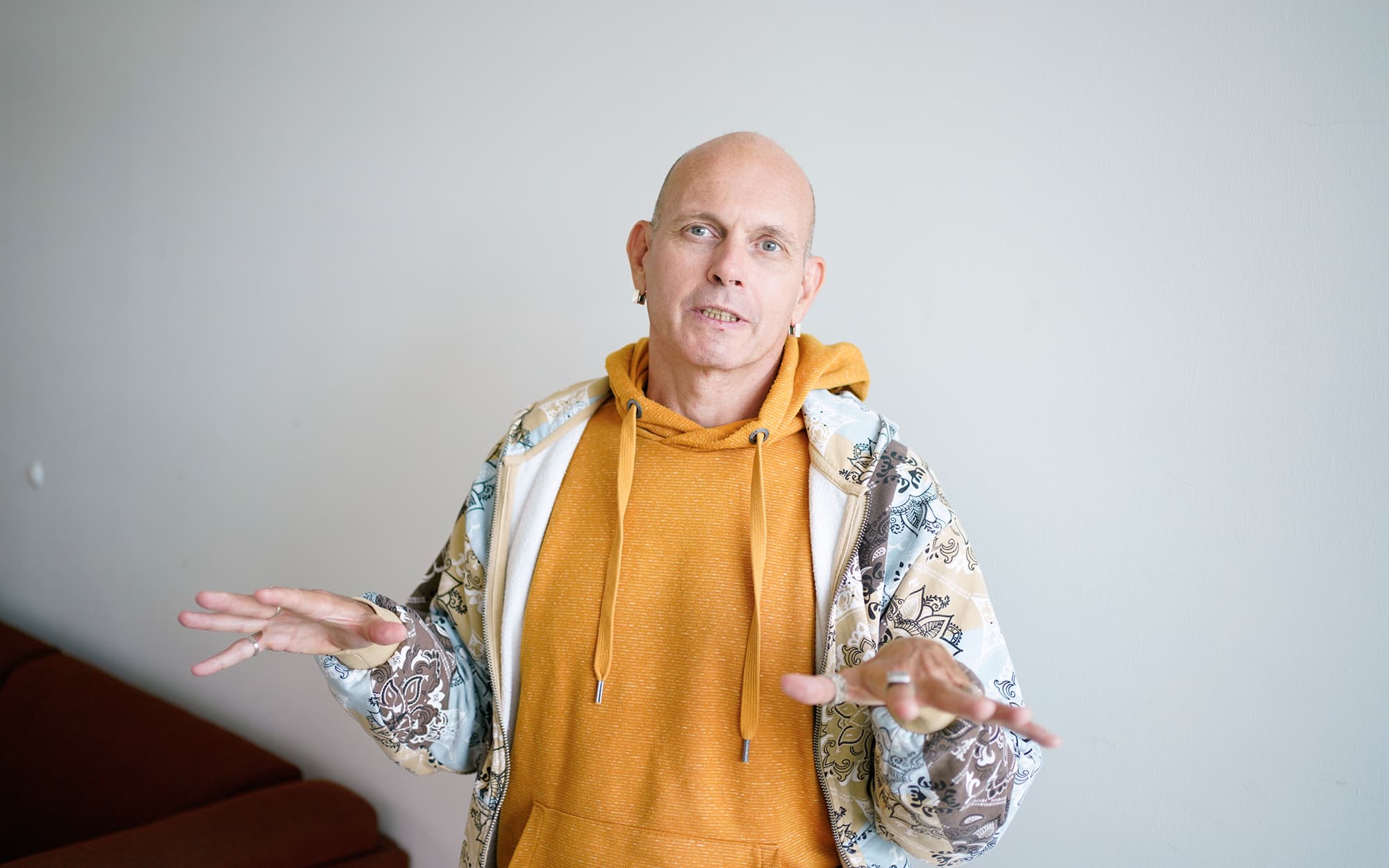
Nicolas Collins

New York born and raised, Nicolas Collins spent most of the 1990s in Europe, where he was the Artistic Director of STEIM (Amsterdam), and a DAAD composer-in-residence in Berlin. For many years he was a Professor in the Department of Sound at the School of the Art Institute of Chicago and Editor-in-Chief of the Leonardo Music Journal, and is currently a Research Fellow at the Orpheus Institute (Ghent). An early adopter of microcomputers for live performance, Collins also makes use of homemade electronic circuitry and conventional acoustic instruments.  His book, Handmade Electronic Music – The Art of Hardware Hacking (Routledge), now in its third edition, has influenced emerging electronic music worldwide. His memoir, Semi-Conducting- Rambles Through the Post-Cagean Thicket, was released by Bloomsbury in 2025.
Loading author details...
Loading similar articles...